

Image Credit: UAA
Two games into his fourth season — a tenure filled with consistent underachievement, lacking discipline, endless coaching changes and baffling decisions both on and off the field — it has become crystal clear that Billy Napier cannot remain head coach of the Florida Gators past the 2025 season.
No. 13 Florida entered Saturday afternoon’s showdown as an 18.5-point favorite against the South Florida Bulls, one of the two most beatable opponents on the toughest schedule in the nation. Sixty minutes of game clock later, with a 18-16 scoreboard in favor of the visitors, the Gators suffered their worst defeat in four years and their most embarrassing loss outside the SEC since 2013.
That 2021 failure as a 20.5-point favorite at South Carolina should have ended the tenure of then-head coach Dan Mullen; he was ultimately fired two weeks later. The 2013 loss to FCS Georgia Southern inside Ben Hill Griffin Stadium should have ended the tenure of then-head coach Will Muschamp; he was, instead, astoundingly, given another season.
Napier, in Year 4 of a seven-year contract worth $51.8 million, does not deserve additional opportunities to drive the Florida program further into the ground than he has already, though the Gators may have no realistic option beyond sticking with him for the majority of the 2025 campaign given the coaching staff he built does not lean on experience.
Regardless, there has been too much Saturday sadness in The Swamp under Napier, and the pitiful performance Florida put forward in Week 2 served as a microcosm of the varied issues that have hampered the Gators across his entire tenure.
Florida started the 2025 season unprepared to play with Saturday marking Napier’s fourth straight 1-1 open in as many seasons. It continues to lower itself to its competition, even in a 55-0 win over LIU of the FCS in Week 1, a game in which sophomore quarterback DJ Lagway compiled just 120 yards passing at halftime.
The Gators remain one of the most undisciplined teams in the nation, this despite Napier preaching before the season that this squad was more disciplined and accountable than any in his prior three years. They committed 11 penalties for 103 yards on Saturday, including two for 28 yards on the final drive, which allowed the Bulls to kick a game-winning, 20-yard field goal with no time remaining.
One of those final two penalties was unsportsmanlike conduct on redshirt sophomore transfer defensive lineman Brendan Bett (Baylor), who got ejected for spitting in an opponent’s face just two nights after he likely watched the same happen to Jalen Carter of the Philadelphia Eagles.
Discipline is not just about penalties but the situationally of those miscues and the way players respond to in-game situations. Florida constantly makes mistakes on third downs (both sides of the ball) and in the red zone.
The Gators were twice caught off guard making substitution errors, one of which led to USF’s lone touchdown of the day, a 66-yard breakaway score that was likely the difference in the game. Florida players were still looking at the sideline when the ball was snapped. In four years — with as many defensive leaders — the Gators continued to prove they have no idea how to handle substitutions against uptempo offenses.
At fault for most of the penalties Saturday was the offensive line, supposedly one of the strongest units of the team and one that has been gifted two position coaches since the month Napier was hired. Employing two OL coaches — which few other teams in the nation do — has neither resulted in high-quality play nor top-tier recruiting for the position. Every spot on the line committed a miscue in the game, and the special teams front botched a snap that led to a safety on a punt attempt, those two points being the differential in the final score.
“The procedure penalties, we can live with the technical failings. There’s always going to be a handful of those. The ones that keep you up at night are the ones that are player decision making,” Napier said. “There’s got to be some ownership there on both ends. They’re under my leadership; it’s ultimately my responsibility.”
And then there’s Napier insisting he remain the offensive play caller, which some of the best in the nation have long realized is a fool’s errand for a college head coach. There have been loud calls for Napier to replace himself in that role since Year 1, yet he has steadfastly refused stating time again that it is his playcalling that made him successful as a coach and ultimately earned him the Florida job. (Napier’s program management and recruiting is the reason he’s had success, not his play calling.)
Despite Napier claiming he thoroughly analyzes his program each offseason to determine where improvements can be made, he has maintained a blindspot to his own faults.
Napier initially hired Rob Sale — the senior offensive line coach — as offensive coordinator despite Sale never calling plays nor serving as the chief play designer. When that failed, he promoted Russ Callaway — who joined Florida has a defensive intern after serving as an offensive analyst in the NFL — three times in as many years to tight ends coach, co-offensive coordinator and then offensive coordinator. Callaway, who actually served as the play caller at Samford from 2016-19, never got the opportunity to take that role despite his promotions and raises.
The Gators entered this season boasting their best wide receiver room in 15 years, yet Napier continues to call plays out of two tight end sets, either bunching up all that speed and talent or not putting it on the field at the same time. His propensity for calling screen passes and starting plays behind the line of scrimmage was mind-numbing for three seasons; now, with Lagway as his signal caller, it’s unconscionable.
Napier’s play-calling ineptitude proves itself beyond the generalities of his offense to the specificity of decisions he makes in crucial situations. Florida constantly stalls around the red zone. Napier regularly calls unnecessary gadget plays — trying to prove he’s smarter than the opposition — that rarely work when regular offense is rolling along just fine.
This showed itself in the second quarter as sophomore running back Jadan Baugh was driving the ball down the Bulls’ throat. Napier first called a double toss trick play that resulted in lost yardage and then a direct snap that went for nothing. In another situation, with UF backed up due to a penalty, he called a quarterback run on first-and-25.
The Gators final offensive possession began with Florida up 16-15 and 2:49 remaining. Lagway threw on first down, which might have been an audible, but it was nevertheless a choice made or coached. Baugh ran on second down for 2 yards. Lagway then threw far deeper than the 8 yards Florida needed to gain on third down, a lower-percentage play than necessary and one that ultimately failed when the ball went through the hands of freshman wide receiver Vernell Brown III. Brown’s drop was seen as the reason the play did not succeed, but again, it was naturally a lower-percentage play than necessary given the down and distance.
Florida only used 12 seconds of game clock with the lead at home facing an opportunity to put the game away. It punted, gifting USF the free stoppage of the 2-minute warning — and another due to the personal foul — before imploding defensively down the stretch. Napier then completely botched the usage of his own timeouts in the final minute.
Napier did not want to discuss his job status in his post-game press conference. It’s frankly tough to blame him considering there is nothing he could have said that would justify this loss to this opponent with the Gators playing the way they did at home in Week 2. If the Bulls had outplayed a disciplined, effective team for 60 minutes, one must tip their hat. That is not what happened Saturday in The Swamp.
Florida now sits 1-1, when it should be 2-0, with its next four games against top 20 teams and eight of its remaining 10 games against ranked opponents. If the Gators cannot win home games like they played Saturday, what chance do they have against some of the best teams in the nation?
“This will be a challenge,” Napier said. “… We’ll have our opportunity to respond This group has been some of these battles before, and hopefully that can help us. I’m more concerned with the football. The football’s got to get better.”
Ironic that Florida’s colossal failure came just one week after athletic director Scott Stricklin received a raise and extension through 2030 despite his own mixed tenure, including disappointing on-field performances from a bevy of coaches he hired (including Napier) as well as allegations of player mistreatment, verbal abuse and sexual misconduct from some of those coaches (not including Napier).
Calming the waters around his position have been his ability to raise money for the UAA — $86 million for the Heavener Football Training Center and Condron Family Ballpark, $399 million to renovate Ben Hill Griffin Stadium — inconsistency at the top of the University of Florida when it comes to the school’s president and the recent success of the men’s basketball program under head coach Todd Golden, a Stricklin hire who led the Gators to the third national championship in program history and first since the departure of Billy Donovan.
Napier is now 20-20 (.500). He entered 2025 coming off his first winning season in three years — including a four-game streak to end the campaign — but saw a nation-best five-game win streak get snapped as a nearly three-touchdown favorite to a Group of Five program. This as Florida had The Swamp at capacity with its 14th straight sellout; fan support both in the stadium and off the field has not been an issue in this new age of college football.
To his credit, Napier acknowledged that the rest of the 2025 season being focused on his job status is no one’s fault but his own: “We created. We deserve it. If you play football like that, you’re going to be criticized. It comes with the territory. Only thing you can do is go get it fixed.”
Recruiting and the development of Lagway had been the tallest feathers in Napier’s cap. Lagway, who missed nearly the entire offseason battling a variety of nagging injuries, has clearly been ill-prepared to play the first two weeks of the season. He’s made bad passes and wrong decisions, simply not looking like the wunderkind who took over for Graham Mertz and raised the hopes of Gator Nation one year ago.
Two games into his second season, it’s probable that Lagway will improve as his health progresses and he gets further opportunities to shake off the rust from an offseason mostly lost.
Two games into his fourth season, it’s proven improbable that Napier is capable of leading Florida back to the only place that matters: national championship contention. (And it’s disastrous for Gator Nation that Stricklin will not only be the one making that decision but choosing his potential replacement.)
 Florida vs. South Florida prediction, pick, preview: Where to watch, TV channel, game time, odds, spread
 Florida Football Friday Final: No. 13 Gators, DJ Lagway must step up vs. South Florida before gauntlet
 Florida vs. Tulane score, takeaways: Gators dominate behind defense in sleepy 2024 Gasparilla Bowl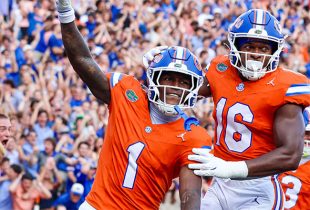
 Florida vs. Campbell prediction, pick and preview: Wher...
September 12, 2026
Florida vs. Campbell prediction, pick and preview: Wher...
September 12, 2026
 Denzel Aberdeen files injunction seeking to play fifth ...
September 12, 2026
Denzel Aberdeen files injunction seeking to play fifth ...
September 12, 2026
 Ben Shelton makes history advancing to 2026 US Open Fin...
September 12, 2026
Ben Shelton makes history advancing to 2026 US Open Fin...
September 12, 2026
 Florida football uniform schedule 2026: Gators wearing ...
September 11, 2026
Florida football uniform schedule 2026: Gators wearing ...
September 11, 2026

 Florida Gators flatten Campbell: Takeaways as Vernell B...
September 12, 2026
Florida vs. Campbell prediction, pick and preview: Wher...
September 12, 2026
Denzel Aberdeen files injunction seeking to play fifth ...
September 12, 2026
Florida Gators flatten Campbell: Takeaways as Vernell B...
September 12, 2026
Florida vs. Campbell prediction, pick and preview: Wher...
September 12, 2026
Denzel Aberdeen files injunction seeking to play fifth ...
September 12, 2026
