Image Credit: ESPN
More than ever before, college football is about the money — which conferences and universities can earn the most, which teams can raise the most, which players can be paid the most. While that has always been the case to some degree, the greatest individual recipients of financial windfalls from the sport had long been head football coaches with their ever-extending contracts and massive buyouts.
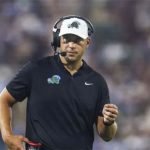
Florida Gators head coach Billy Napier was handed the richest deal in program history when he was the lone top man targeted by athletic director Scott Stricklin before the 2022 season. His seven-year, $51.8 million deal made him one of the SEC’s highest paid coaches, and it came along with a substantial buyout that would guarantee Napier 85% of his remaining salary — without mitigation — should he be fired without cause by the University Athletic Association.
Given the 2025 season is already underway, guaranteeing Napier’s salary for the year, Florida’s coach would be owed 85% of the remaining $22.8 million he would otherwise be paid for the 2026-28 seasons. (This includes an annual $100,000 escalator each year.) Thus, Napier’s total buyout would amount to $19.38 million, 50% of which ($9.69 million) would be due within 30 days of Napier being fired with the other $9.69 million paid out across the remaining term.
Because there is a no-mitigation clause baked into the deal, should Napier get hired by another university, his new salary would not offset what the UAA owes for his ouster.
Standing with a 20-20 record two games into his fourth season leading the Gators — following an embarrassing 18-16 loss to South Florida on Saturday, the worst defeat by the program in 12 seasons and first loss in The Swamp to a Sunshine State team other than Florida State or Miami since 1938 — Napier has the worst record through 40 games for a UF coach in more than 40 years. Charley Pell (18-21-1, .450) was handicapped by a 0-10-1 inaugural season but posted four straight winning campaigns in the 1980s, something Napier has only achieved once (barely) in three years.
Making matters worse is that Napier has received greater investment from the university, its donors and fans than any predecessor in Florida football history.
Stricklin, for all his faults, raised $86 million for the state-of-the-art Heavener Football Training Center, a beacon that had served the Gators incredibly well in recruiting. He also successfully obtained enough money to buy out Napier’s contract during the 2024 season (likely $15 million, 50% of an approximate $30 million total that would have been owed). When that became unnecessary after the team ended the season on an impressive-yet-surprising four-game winning streak, Stricklin convinced many of Florida’s boosters to reinvest those funds as a means of securing and recruiting talent.
Despite the Gators’ on-field struggles through Napier’s first two seasons and continually rising prices for non-students amid a struggling economy, fans have sold out 14 straight games in The Swamp. Florida football is not hurting for resources or support.
Napier appears to be flushing money — not the kind that jingles, the kind that folds — down the toilet with each passing week.
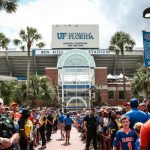
How else does one explain his inability to utilize the best group of playmakers that has graced Ben Hill Griffin Stadium in 15 years?
How does one explain Napier’s strategy for hiring — and paying — three “defensive coordinators” while promoting an inexperienced “offensive coordinator” who does not even call plays?
How does one explain an offensive line with two position coaches struggling for four years not only on the field but in recruiting top talent?
How does one explain that Napier needed an NCAA rule change to bail him out of being the only coach in the nation without a dedicated on-field special teams coordinator for the first two seasons?
How does one explain that Napier has one of the largest overall staffs in the entire nation yet has only emerged victorious of 50% of his first 40 games with one season barely over .500 in that stretch?
In Year 4, there is no one else who can shoulder the blame.
Not all investments pay off. It does not take a Wall Street wunderkind of Silicon Valley player to tell you that. But the best investors not only know when to buy, they know when to sell — even if the asset has already depreciated beyond the point of no return.
For all his qualities as a recruiter, mentor and role model for players, Napier appears to be that depreciated asset. And if Florida can save 15% over the next three years while mitigating further losses — booster support, fan support, talent departures through the transfer portal — that’s almost certainly an investment in the future worth making.
Perhaps Napier has known his funeral was coming since the day he took the Gators job. After all, he’s been wearing black on the sideline, game after game, for four seasons.
 Florida vs. Ole Miss prediction, pick and preview: Wher...
September 26, 2026
Florida vs. Ole Miss prediction, pick and preview: Wher...
September 26, 2026
 Florida Football Friday Final: No. 21 Gators face famil...
September 25, 2026
Florida Football Friday Final: No. 21 Gators face famil...
September 25, 2026
 College football rankings: Florida Gators enter AP Top ...
September 20, 2026
College football rankings: Florida Gators enter AP Top ...
September 20, 2026
 Florida vanquishes Auburn: Takeaways as Jadan Baugh eru...
September 19, 2026
Florida vanquishes Auburn: Takeaways as Jadan Baugh eru...
September 19, 2026

 No. 21 Florida quells No. 4 Ole Miss: Takeaways as Gato...
September 26, 2026
Florida vs. Ole Miss prediction, pick and preview: Wher...
September 26, 2026
Florida Football Friday Final: No. 21 Gators face famil...
September 25, 2026
No. 21 Florida quells No. 4 Ole Miss: Takeaways as Gato...
September 26, 2026
Florida vs. Ole Miss prediction, pick and preview: Wher...
September 26, 2026
Florida Football Friday Final: No. 21 Gators face famil...
September 25, 2026