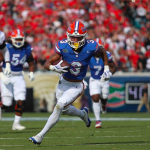
Image Credit: ESPN
In the immediate aftermath of the Florida Gators’ 31-11 victory over the Florida State Seminoles on Saturday night, conversation was not centered around Florida winning three straight games to end the regular season (for the first time since 2019) or the Gators’ immense late momentum carrying into the offseason. Rather, it was the actions of Florida players near midfield at Doak Campbell Stadium that had fans tweeting their fingers off and coaches issuing statements in their post-game press conferences.
At issue was the Gators planting their flag for a few seconds on the Seminoles’ logo. Only a few seconds because Florida State head coach Mike Norvell threw a fit seeing the action, chiding Florida head coach Billy Napier for the UF players’ actions and acting more concerned about removing the flag than stopping FSU players from engaging in a mini-melee.
Norvell and his fan base are apparently offended that Florida — like Michigan and Arizona State on Saturday … and hundreds of other teams in the history of college football — treated Rivalry Week … like Rivalry Week.
And really, the entire conversation boils down to a singular point: If you don’t want your rival to celebrate on your field after a win, don’t let them win on your field.
College football is slowly but surely moving away from everything that makes it special. Conference realignment and oversized leagues have led to the end of many rivalries. Teams are flying 3,000 miles to play conference opponents. NIL rights and the transfer portal, while important for players, were thrown into existence without much in the way of legislation to keep the playing field even. Traditional bowl games have largely become meaningless. Players actually have less freedoms to celebrate touchdowns and turnovers compared to their NFL (No Fun League) counterparts.
There’s even inconsistencies in how teams are treated from a taunting perspective. “Horns Down” was previously disallowed by the Big 12 to protect the feelings of Texas fans while opposing players have always been allowed to Gator Chomp no matter the game situation against Florida.
Here’s a harsh truth: It’s OK to have your feelings hurt. And it’s OK for young adults to celebrate rivalry wins — particularly in the final week of the season after grinding in practice and busting their asses for five straight months on the gridiron while simultaneously being expected to perform as students.
At some point, to some degree, players need to be allowed to express themselves. Where is the uproar when the likes of FSU and LSU stomp the mud out of the Gators’ logo while parading around with a gator head? Did Ole Miss complain last week that Florida literally ran a dunking line on its celebration basketball hoop?
What about when Florida State literally cuts a chunk out of the opponent’s turf and celebrates with it for the “sod cemetery?” Is it FSU tradition? Sure. It is also far more damaging to the playing surface yet no one disallows it or tells the ‘Noles they can’t do it.
Is redshirt junior EDGE George Gumbs Jr. planting a flag into the field — causing more damage to feelings than actual grass — really worth this much commotion?!
Again, if you don’t want it to occur, don’t lose on your home field during Rivalry Week — especially by 20 points (Florida State, which has gotten the best of Florida for years) or as double-digit underdogs (Ohio State).
“What happened there at the end of the game is not who we want to be as a program, OK? It’s embarrassing to me, and it’s a distraction from a really well-played football game,” Napier said after the game. “I want to apologize on behalf of the entire organization just in terms of the way we represented the university there. We shouldn’t have done that, and we won’t do that going forward. There will be consequences for all involved.”
Napier apologized for the Gators’ actions because he’s the adult in the room. And from a public-facing standpoint, it is appropriate for coaches to take such a stance. He’s a good man — perhaps better than many of us — but punishing Florida players beyond some extra sprints in practice would be a mistake.
To Napier’s point, planting the flag was indeed bad sportsmanship on UF’s behalf. That’s also the case when an NFL player does the “dirty bird” after scoring on the Atlanta Falcons or Ray Lewis’ celebration when beating the Baltimore Ravens. That’s also the case when players Gator Chomp after making an impact play on Florida (which happens in literally every game). And it’s certainly the case when a coach barely shakes their opponent’s hand because their feelings were hurt.
Norvell throwing a temper tantrum to Napier at midfield (despite Napier immediately telling his counterpart that his team was in the wrong) and going so far as to toss the Florida flag to the ground (as if it was some defiant act) was a straight-up loser move. As embattled as Ryan Day has been at Ohio State, you did not see him act like a child after Michigan won earlier Saturday — and the Wolverines may have single-handedly cost Day his actual job.
You can be sure that flag planting will be legislated against by the NCAA this offseason. It’s a no-brainer move given the controversy created Saturday — primarily at Ohio Stadium where players from both teams were pepper sprayed by police as the action ultimately led to a full-fledged brawl.
Yet despite surely adding another protection for the feelings of players and fans, the nine conferences that comprise the FBS continue to have no solution to actual dangers — like game attendees rushing the field at will to the point that it’s even become a common occurrence in the SEC, which had historically taken significant action to combat stormings. Most SEC teams long believed it was beneath them to pull that trigger outside of rare circumstances involving shocking upsets or incredible game finishes; now, it seems to happen weekly.

What must be decided by those in charge is how to determine which celebrations are appropriate and which step over a to-this-point nonexistent line. It’s not OK to plant a flag, apparently, but it’s perfectly fine to stomp a mudhole in the same spot? Is it also OK for UF’s rivals to parade around with a gator head or, as Chauncey Gardner-Johnson did years ago, celebrate with a decapitated Seminole head? That’s not more offensive than putting a piece of metal in the ground?!
The truth is that Florida planted two flags at Doak Campbell Stadium on Saturday night. The physical one, which obviously created this low-level controversy, and a proverbial one as the Gators regained the upper hand not only on the ‘Noles but perhaps the entire Sunshine State (given the way Miami has played of late).
If Florida State or any other team doesn’t want that to happen … don’t lose.
 Florida Gators flatten Campbell: Takeaways as Vernell B...
September 12, 2026
Florida Gators flatten Campbell: Takeaways as Vernell B...
September 12, 2026
 Florida vs. Campbell prediction, pick and preview: Wher...
September 12, 2026
Florida vs. Campbell prediction, pick and preview: Wher...
September 12, 2026
 Denzel Aberdeen files injunction seeking to play fifth ...
September 12, 2026
Denzel Aberdeen files injunction seeking to play fifth ...
September 12, 2026
 Ben Shelton makes history advancing to 2026 US Open Fin...
September 12, 2026
Ben Shelton makes history advancing to 2026 US Open Fin...
September 12, 2026

 Florida Football Friday Final: Gators still work in pro...
September 18, 2026
Florida Gators flatten Campbell: Takeaways as Vernell B...
September 12, 2026
Florida vs. Campbell prediction, pick and preview: Wher...
September 12, 2026
Florida Football Friday Final: Gators still work in pro...
September 18, 2026
Florida Gators flatten Campbell: Takeaways as Vernell B...
September 12, 2026
Florida vs. Campbell prediction, pick and preview: Wher...
September 12, 2026