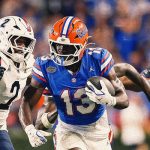
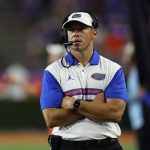
Image Credit: UAA
Fifteen years is a lot of time. The last time the Florida Gators visited the Auburn Tigers, cable television was still the medium of choice, electric vehicles were niche products, Uber was a “black car” service available in select cities and Siri was introduced by Apple as a virtual assistant with the likes of ChatGPT and Claude barely a thought in anyone’s mind.
The SEC’s clunky, inconsistent and (at times) unfair scheduling procedures over the last decade and a half kept apart two former annual — once legitimate rivals — for no good reason. Florida and Auburn have only played twice in the last 19 years despite facing off annually from World War II to 2002 (and before that, from 1927-40).
Steve Spurrier kicked a go-ahead 40-yard field goal to beat the Tigers in his 1966 Heisman Trophy season. Kerwin Bell led an incredible fourth-quarter comeback in 1986 (after the Gators stifled eventual Heisman winner Bo Jackson the year prior). Spurrier burst onto the national scene as a coach in 1990, winning 48-7 in a blowout that stood as the worst loss of Pat Dye’s career. Auburn got a measure of revenge by upsetting Florida in 1993-94, seriously altering the team’s postseason goals across consecutive seasons.
This was SEC history that mattered … until it was brushed aside … as is presently happening with other long-term rivalries ended due to a new scheduling format enacted this season. Alas, a conversation for another day.
The larger point: When the Gators and Tigers squared off on the gridiron, the nation took notice. The teams will be back in primetime Saturday night, though each is a program (hopefully) on the upswing with new head coaches aiming to make an impact in Year 1.
Jon Sumrall is off to a 2-0 start at Florida with offensive coordinator Buster Faulkner leading one of the best starts in program history. The defense clearly needs work, but the Gators piled up points in the nonconference slate, priming them for a potential reality check when they go up against a tough Auburn team led by Alex Golesh, who beat UF in The Swamp while leading South Florida last season, and former Florida special teams coordinator D.J. Durkin, who is atop the Tigers’ defensive ranks.
The familiarity goes both ways, though. Sumrall’s wife attended Auburn, and her half of the family has long rooted for AU. Though the coach may have once held a soft spot for the darker orange & blue uniforms, he made it crystal clear — in his trademark deadpan fashion — there should be no split allegiances come Saturday night at Jordan-Hare Stadium.
“If they do [root for Auburn], they’re not family to me. But yeah, you have a lot of Auburn ties on that side of the family,” Sumrall said. “Florida pays by mortgage. So any family that is pulling against us, they ain’t my family. I don’t care what their last name is, you know what I mean? … I’m a Florida Gator, and everybody affiliated with me closely is a Florida Gator.”
Those ties aside, Sumrall does acknowledge the Tigers will present a difficult test as the Gators open SEC play on the road.
“Have a real challenge on our hands. Auburn is a really good football team: a lot of talented players, a good coaching staff,” he said. “… The challenge is they got good players, and they do good stuff schematically, but they’re doing it with good people, too, which we have to win our one-on-one battles.”
What has become clear less than a month into the regular season is that Sumrall’s messages reverberate. To a person, his staff and players have largely shrugged off the concept of opening the SEC schedule with a road game, since every team will play about half its league contests on the road, whenever they might come.
Rather, it’s starting SEC play at all that has Sumrall’s attention, as he often claims league games “count twice” or teams — once for their overall record (national goals) and again for their conference record.
“I like playing football: home, road, parking lot, don’t matter,” he said.
“If there’s a whole lot that needs to be said to get anybody in this building ready to go play in SEC football games, we got the wrong people here. And I’ll say some things to them to hopefully get them ready, but there should be some self-motivation here,” he added later.
While the Gators worked crowd noise into practice all week, Sumrall admitted there is no true way to authentically simulate what it is like to be on the gridiron under the lights in an SEC stadium, especially a “great venue” and “historic place” like Jordan-Hare.
“It is going to be a hostile environment. Our offense on the field is going to be loud. We know that going in. We can’t let it affect how we play,” said Sumrall, who pointed out that staying composed and locked in — never getting too high or too low — is what will help Florida win road games. “We may have to change some things we do to play clean, but that’s a lot of the time in these types of situations. That’s an indicator for your opportunity to win: handling the environment, not even letting it affect how you operate.”
Faulkner agreed: “Each week, it’s the same exact preparation. We’re going to prepare the same way every week, no matter who we’re playing. … That’s what they pay us to do.”
Most impacted by raucous road environments is the office, specifically the quarterback. While junior Aaron Philo played at Virginia Tech as a true freshman (in a 21-6 loss), that is the only time in his collegiate career he saw the field away from his home stadium. Philo has been lights out through two weeks, compiling seven total touchdowns in about six quarters, but this will be another beast in Alabama.
“He was in a quarterback competition for months. That’s pressure every day,” Faulkner said of his protoge, while putting over his ability to deliver off-schedule throws. “… Everything that we’ve done, all that stuff is designed to be able to go play anywhere. We know that playing on the road in the SEC is really tough. You’re not just playing against 11 defenders; you got the crowd, and we got to do a great job of handling that. One thing about him is he’s pretty cool, calm and collected. We’ll coach him through it.”
Sumrall remains impressed with Philo’s leadership, confidence, competitive nature and ability to relate to his teammates, noting that his short memory and coachability are irreplaceable traits.
“Not a guy that seeks the attention, which I’m a firm believer that you want your quarterbacks to be more worried about being a quarterback than a superstar — and hopefully they become superstars,” he explained. “If they’re worried about all the other stuff [first], then doing their job, then you have a real problem. He’s not worried about all the other stuff.
“He’s been really, really steady. He’s made a lot of good decisions. Doesn’t mean he’s played perfect, but he’s done a lot of things that, if he plays like he’s played through the first part of this year, he will give us a chance to win every week. And that’s all you can ask.”
As expected heading into the season, the wide receiver room has been the most impressive individual position group Florida has fielded through two games. Loaded with talent and explosive athletic ability, the Gators wideouts have understood that individual glory is welcome, but the group’s overall success is more important. Sumrall specifically shouted out the culture developed by passing game coordinator Trent McKnight and outside WR coach Marcus Davis, which extends beyond the tremendous play of sophomores Vernell Brown III and Dallas Wilson.
Perhaps no player exemplifies that culture better than senior Bailey Stockton. Though the 5-foot-10, 183-pound wideout only has 61 yards receiving, he has been all over the field the last two weeks, blocking out wide and downfield, opening holes and creating lanes for his position mates and the running backs.
“I’ve said it for years. Bailey Stockton is a heck of a football player — one of the toughest kids you’ll ever be around,” said Faulkner, who brought Stockton with him to Florida from Georgia Tech. “He’s been in some loaded wide receiver rooms. We have zero doubt, if he’s got to play 90 snaps, he’ll go out there and give you everything he’s got for 90 snaps. He knows the offense. He’s faster than you think. He gets open probably as good as anybody.”
Sumrall felt similarly: “Bailey plays really, really, really hard without the football. And that is the true character of a skilled player is how do you play when you don’t have the ball? There’s nothing that brings more joy to my heart than watching a skilled offensive player block their ass off. That’s one of my favorite things to watch.”
Similarly unheralded have been Florida’s tight ends, a group that entered the season on the opposite end of the spectrum from the receivers. Considered a patchwork unit that might take most of the year to gel, the players have come together and contributed far quicker than expected with assistant Evan McKissack receiving plenty of credit for his role in coaching up the group.
“Our tight ends, honestly, have played above what probably even I expected at times going into the year. They’ve all done a nice job. … Those guys are blocking great on the outside, and that’s fun to watch,” said Sumrall. Faulkner was in full agreement: “I can’t say enough [about] where they’ve come from the time we got here in January to where they are now. And it’s all of them.”
The battle that may decide Saturday night’s game is junior running back Jadan Baugh against Durkin’s dominant rush defense. Referred to as “one of the best coordinators in college football,” who is supplemented by “good personnel,” Durkin received praise from Sumrall and Fauklner for what he has already achieved leading Auburn’s defense.
“They’re really good against the run, but they seem to do a good job at kind of preventing the short passing game from getting going, too,” Faulkner explained. “… DJ’s done a great job everywhere he’s ever been. … He tries to stay a step ahead of you. He’s always presenting a bunch of different looks, which makes it tough on an offense. … They play with their hair on fire. They play fast. They play with confidence. … It’s going to be a big challenge for us on the road.”
Baugh has run for 135+ yards in three straight games (dating back to 2025), scoring seven touchdowns in those contests. As one of the most dominant ball carriers in the nation, the Gators largely move as he moves. Since the start of 2025, Florida is 6-0 when he eclipses 100 yards rushed in a game, 0-8 otherwise.
The Gators defense this season has been … OK. Due to a combination of youth, inexperience and overall lacking talent, Florida has put some concerning play on film through the first two weeks. Though Auburn has hardly been lighting up the scoreboard — pulling off a squaker, 17-16 over Baylor, in Week 1 — UF can only focus on its own lackluster play. It doesn’t have time to worry about its opponent’s issues.
While there have been problems defending the pass and crowding the middle of the field, the Gators’ lack of pass rush has been the most obvious outstanding issue.
Sumrall noted that FAU and Campbell did not provide many opportunities for edge defenders to get home, given how many quick passes and screens were called in those games, though UF was close more often than others acknowledged.
“We got to finish on the quarterback. I’d like for us to get a lot of sacks. More importantly than sacks, it’s affecting the quarterback, which could mean, hey, you force him to throw it quicker than he wants to, or you flush him from the pocket, and he’s having to make a throw that’s on the run, maybe in a place that he’s not as comfortable throwing the football. I’m all for sacks. I like getting more sacks.”
No one is under more pressure to put the quarterback into the grass than sophomore EDGE Jayden Woods, one of Sumrall’s signature retentions from the offseason and — as notable these days — one of the highest-paid players on Florida’s roster. Woods has half of a sack and five total solo in two games.
“There’s some things that he could do better and some things we can do to help him better,” the coach said. “… Sometimes, when a guy has a [hyped] offseason, there’s this expectation he’s going to come out in Game 1 and have three sacks and Game 2 have five sacks. Sometimes, opportunities don’t always present as clean as you hope they do. He’ll get his. He’s just got to keep showing up and keep preparing the right way, but he’s not doing anything poor. But he there’s still a lot out there for him to grow and improve upon.”
Defensive coordinator Brad White clarified that Woods is still growing and understanding his rush patterns, game-start philosophies and attack plans. Now that Woods got his first QB hit out of the way last week, White believes the floodgates could open, just like when a baseball player hits a home run coming off a cold spell.
“I expect and anticipate him continuing to excel and elevate his game as [the season] goes on,” he said. “… Everybody forgets that he’s just a true sophomore and every rep he gets, every play he gets, we get to teach off of, and he learns and he takes it serious.”
While senior tight end Evan Chieca practiced this week and will return to the field on Saturday, senior WR Eric Singleton Jr. and fifth-year defensive lineman Emmanuel Oyebadejo are both listed as questionable on Thursday’s injury report with ankle injuries. They effectively missed practice on Monday with Sumrall calling them “questionable” at the start of the week, refusing to acknowledge the likelihood of either or both playing come Saturday night. Singleton, who previously played for the Tigers, surely wants a shot against his former school but will not be able to suit up unless trainers are in agreement.
“I’m not going to rush either one of them back and [have] them not be right because it’s a long season,” Sumrall said. “… We got to be smart-tough, not dumb-tough. If they’re not ready to play the right way for themselves, it’s going to hurt the team.”
 Florida Gators flatten Campbell: Takeaways as Vernell B...
September 12, 2026
Florida Gators flatten Campbell: Takeaways as Vernell B...
September 12, 2026
 Florida vs. Campbell prediction, pick and preview: Wher...
September 12, 2026
Florida vs. Campbell prediction, pick and preview: Wher...
September 12, 2026
 Denzel Aberdeen files injunction seeking to play fifth ...
September 12, 2026
Denzel Aberdeen files injunction seeking to play fifth ...
September 12, 2026
 Ben Shelton makes history advancing to 2026 US Open Fin...
September 12, 2026
Ben Shelton makes history advancing to 2026 US Open Fin...
September 12, 2026

 Florida Football Friday Final: Gators still work in pro...
September 18, 2026
Florida Gators flatten Campbell: Takeaways as Vernell B...
September 12, 2026
Florida vs. Campbell prediction, pick and preview: Wher...
September 12, 2026
Florida Football Friday Final: Gators still work in pro...
September 18, 2026
Florida Gators flatten Campbell: Takeaways as Vernell B...
September 12, 2026
Florida vs. Campbell prediction, pick and preview: Wher...
September 12, 2026