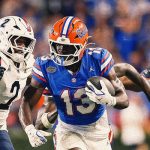
Image Credit: Jordan Perez, UAA
It’s showtime! The 2026 college football season is already underway with the Florida Gators aiming for a rebirth under new head coach Jon Sumrall. Florida kicks off its campaign Saturday against FAU, and OnlyGators.com kicks off its coverage in this space with an all-encompassing look at how the Gators have progressed this offseason and what you should expect in Year 1 under the program’s fifth full-time head coach since Urban Meyer’s departure.
After 17 years of comprehensive, around-the-clock coverage, OnlyGators.com took this summer off. While that resulted in content production grinding to a halt, our attention remained firmly focused on what was happening throughout the program as Sumrall and offensive coordinator Buster Faulkner began attempting to turn around a team that has slid in the SEC and college football hierarchy despite being one of the best and most well-funded programs in the nation.
When it comes to Sumrall, it’s buzzwords galore, though nothing in his demeanor suggests that he will not achieve his goals. He wants the program, overall, to be urgent, tough, accountable and competitive with players and coaches who are neither complacent nor excuse-oriented. He wants the offense to be versatile, physical and productive, while the defense is aggressive, physical (surprise!) and multiple. And he wants special teams to impact all phases of production. All of that sounds great, of course. Saturday will be the first opportunity to put that talk into action.
With hopes raised, time short and the Week 1 depth chart officially released, let’s look at everything you need to know to fully catch up on the Gators with kickoff ahead.
Whereas his predecessor believed Florida needed a teardown rebuild — which appeared to be never-ending, considering his lack of progress — Sumrall did not have the luxury to step into Ben Hill Griffin Stadium and expect Gators fans to be OK with short-term losses in hopes of greater long-term glory. Even better, such a concept is antithetical to his personality.
So while the numbers are stark — 13 new primary coaches and 50 (!) new players on the 112-man roster — what most impressed most about Sumrall this offseason was the attention he paid to retaining talent while ensuring cohesiveness among his acquisitions.
Even if some took longer than originally hoped, Sumrall went 5 for 5 in his primary re-recruitment battles, ensuring that Florida’s top players returned to wear orange & blue in 2026. Junior running back Jadan Baugh, sophomore wide receivers Vernell Brown III and Dallas Wilson, junior linebacker Myles Graham and sophomore EDGE Jayden Woods are all back with the Gators.
Baugh (UF’s first 1,000-yard rusher since 2015) and Graham have already proven their worth. Brown broke out (in spurts) during his freshman campaign, while Wilson flashed superstar potential but only suited up four times due to nagging, untimely injuries. Woods was the toughest to retain — he entered the transfer portal only to get plucked out of it — but his upside is tremendous.
Sumrall focused on supplementing this core of top-level talent with complementary pieces capable of playing SEC-level football and contributing immediately. It was a wholly different plan of attack than his predecessor employed, and it acknowledged that Sumrall was focused on the program’s success over the pride that comes with wanting wholesale ownership of the roster’s composition.
While Florida may not have landed the biggest names available in the transfer portal, plenty of additions are on track to be immediate contributors with potentially significant roles as the season progresses. None is more important than junior quarterback Aaron Philo, of course, a transfer from Georgia Tech who beat out sophomore Tramell Jones Jr. for the Week 1 starting job. Sumrall made it clear that the competition is not over; however, Philo’s familiarity with offensive coordinator Buster Faulkner’s scheme and calls, along with his more fluid operation at the line of scrimmage, made the long-expected move a reality.
Sixth-year senior RB Evan Pryor will serve as Baugh’s primary backup, coming off a stint at Cincinnati after originally signing with Ohio State. He registered career-highs of 76 carries and 522 yards with four total touchdowns last season as one of the Bearcats’ top playmakers.
Senior WR Eric Singleton Jr., a former Georgia Tech standout, links with Faulkner again after a brief respite and productive campaign at Auburn (where he was led by WR coach Marcus Davis). Given his immense speed and familiarity with the offensive system, Singleton enters the season as arguably the team’s second-most important newcomer. His speed makes him the player most likely to turn Faulkner’s schematic creativity into explosive plays and a legitimate advantage.
Senior safety DJ Coleman has stepped into a starting role, aiming to become the second Baylor transfer in as many years to help fill holes on the defensive side of the ball. He started all but one game for the Bears last season, and while the numbers do not jump off the page, considering he played nearly 600 snaps, his immense experience as a back-end stalwart should pay dividends, particularly early in the season.
The Gators’ greatest roster shift occurred on special teams, where all three of its primary starters exited. Sumrall replaced them with his starters from Tulane last season as junior kicker Patrick Durkin and senior punter Alec Clark (an Australian who started his college football career at Marshall) will handle duties. Durkin made 89% of his field goals last season, converting 4 of 6 from 50+ yards, while Cark averaged 46.5 yards per punt — both successful but not overwhelming in their performances.
There may be no more important addition to the Gators, year over year, than Faulkner. While he does not wear the head coach whistle around his neck, considering the state of Florida’s offense, a top-down schematic rebuild was necessary, and there may not have been anyone in college football more primed for the opportunity.
The highly acclaimed Faulkner will employ a unique pro-style hybrid offense, which he describes as a mix of NFL and college (even high school) concepts — with ultimate goals of playmaking and versatility. He wants the Gators to succeed running even when the entire stadium knows it’s a running play and gain chunk yardage passing even when defenses know the down and distance indicate a throwing play.
That is easier said than done, of course, but Faulkner has given no indication that he plans to use only a portion of his vast playbook. In fact, he’s matter-of-factly stated that labeling Florida’s offense is not his goal. From one game to the next, you may see various levels of motions and shifts, RPO elements, deep vertical passes, perimeter screen throws, four-receiver formations, multiple tight ends in the receiving game, play actions, quarterback runs and even gadget plays. His ability to flip formations and disguise looks is lauded in coaching circles.
The impact of defensive coordinator Brad White is less clear, given that his time at Kentucky was spent under Mark Stoops, a defensive coach, and Sumrall will certainly be more involved on that side of the ball, at least initially. Whereas Faulkner is attempting to create explosive plays from underutilized talent, White is trying to develop and position his players for more consistent success — particularly in getting off the field and creating turnovers.
White’s philosophy, like that of Sumrall, boils down to inflicting damage rather than accepting it. There will be immense physicality and regular pressure, playing into the “attack, don’t react” concept, and the Gators will employ a variety of fronts with plenty of disguises, regularly alternating between 3-4 and 4-3 bases. White will need to lean on an experienced linebacking corps — primarily Graham, junior Aaron Chiles and senior Jaden Robinson — to lead a unit undergoing a significant shift in the secondary.
As Sumrall said this spring: “I’m a firm believer most football games are not won, but lost, because someone will tap out.”
Coaches are all about controlling the controllables; it’s a mindset they pass on to players in hopes of focusing on what matters and blocking out what does not. What can rarely be helped, though, is overall player health and the team’s schedule. Some years, teams enter the season already wounded. In other years, as Florida experienced over the last two seasons, the schedule is so tough that it is inequitable. Sometimes, those unmanageable struggles coincide, creating a perfect storm of difficulty.
The Gators escaped the spring and summer relatively unscathed. Wilson and Graham are healthy. Junior defensive lineman LJ McCray is ready to go after missing nearly his entire sophomore campaign. Even senior cornerback Dijon Johnson is back in the mix. While absent from the two-deep depth chart, having undergone a clean-up procedure this summer, his recovery could be completed before kickoff, giving Florida a key piece to add to the secondary early in the season.
And while the Gators still have a difficult schedule, it is not firmly the “toughest in the nation” entering the season, as it was ahead of the 2024 and 2025 campaigns.
Florida’s strength-of-schedule ranking ranges from fifth to 15th, depending on who you ask, but those metrics are largely based solely on opponent quality and not circumstances, such as which games are played home and away, whether opponents face difficult teams or cupcakes before playing UF, how ranked opponents are stacked, etc. (The Gators entered 2024 and 2025 at extreme disadvantages in many of those categories.)
Florida does not play a preseason-ranked opponent in the first three or final three weeks of the season, creating opportunities for a fast start and strong close. At the same time, the Gators do not play consecutive home games against power conference opponents at any point.
UF moves from an away game at Auburn to hosting No. 9 Ole Miss in The Swamp. The most brutal stretch comes around the off week as Florida plays at No. 5 Texas and No. 3 Georgia (in Atlanta) back-to-back with a much-needed off-week respite between those contests. The Gators’ most difficult turnaround comes when they play No. 10 Oklahoma immediately after UGA, but at least that game is back in The Swamp.
It’s not all rosy for Florida as it enters Year 1 under Sumrall. It’s impossible for any coach to correct such a wide swath of issues in a single offseason, and while the Gators may flash in a variety of key areas this season, there will be growing pains (at best) and pitfalls (at worst) in some others.
Florida finished last season at 4-8, its fourth losing season in five years, hopefully concluding one of the worst stretches in program history. The Gators enter 2026 with Sumrall attempting to repair a broken identity, an underperforming offense and an inconsistent defense with a radically rebuilt roster featuring a handful of genuine stars and an enormous number of unanswered questions.
It is not a simple task, and there will undoubtedly be hiccups and speed bumps over the next three-plus months, but early indications have Florida poised for some form of turnaround this season. If the Gators can truly turn the tide in Year 1 under Sumrall, there’s no telling what they might be able to accomplish once the program is reestablished as a force to be reckoned with.
 Florida swamps No. 7 Texas: Takeaways as Tramell Jones ...
October 17, 2026
Florida swamps No. 7 Texas: Takeaways as Tramell Jones ...
October 17, 2026
 Florida vs. Texas prediction, pick and preview: Where t...
October 17, 2026
Florida vs. Texas prediction, pick and preview: Where t...
October 17, 2026
 Florida QB Aaron Philo’s status in question vs. T...
October 14, 2026
Florida QB Aaron Philo’s status in question vs. T...
October 14, 2026
 Florida football recruiting: Five-star WR Easton Royal ...
October 11, 2026
Florida football recruiting: Five-star WR Easton Royal ...
October 11, 2026

 College football rankings: Florida Gators reenter AP To...
October 18, 2026
Florida swamps No. 7 Texas: Takeaways as Tramell Jones ...
October 17, 2026
Florida vs. Texas prediction, pick and preview: Where t...
October 17, 2026
College football rankings: Florida Gators reenter AP To...
October 18, 2026
Florida swamps No. 7 Texas: Takeaways as Tramell Jones ...
October 17, 2026
Florida vs. Texas prediction, pick and preview: Where t...
October 17, 2026